April 2026 · 7 min read
You cycled your tank. You did everything right. And now your rock is covered in brown slime, your glass is coated in green, and there's a purple-red crust forming in the corner that you've never seen before.
Welcome to the Ugly Phase. Every new reef tank goes through it. Most new reefers panic. Some tear their tank down. Almost all of them shouldn't.
This guide explains exactly what's happening, which algae is which, and how to get through it — without nuking your tank or going back to square one.
After a tank cycles, it goes through a period — typically 2–4 months — where nutrients are elevated and the biological systems haven't fully stabilized. During this window, various algae species bloom, dominate for a few weeks, then get outcompeted by the next species.
It's actually a sign your tank is maturing correctly. The succession of algae types follows a predictable pattern, and understanding that pattern removes a lot of the anxiety.
The ugly phase is not a problem to solve — it's a process to survive.
Interventions that seem helpful — big water changes, algaecides, lights-off periods — often reset the succession cycle and extend the ugly phase. The fastest path through it is consistent maintenance and patience.
New tanks typically go through algae types in this order. Each one outcompetes and eventually replaces the last.
Diatoms (Brown Film Algae)
Weeks 1–4 post-cycleWHAT IT LOOKS LIKE
Dusty brown or rust-colored film coating rock, sand, and glass. Looks like someone sprinkled cocoa powder in your tank.
WHY IT'S HAPPENING
Silicates from new sand, rock, and sometimes tap water or low-quality RODI. Diatoms consume silicate and are almost universal in new tanks.
WHAT TO DO
Nassarius snails and cerith snails will eat diatoms off the sand bed. Trochus and turbo snails handle glass and rock. Your cleanup crew is your best friend here.
HOW LONG IT LASTS
Usually clears within 4–6 weeks as silicate is depleted.
Green Hair Algae (GHA)
Months 1–3WHAT IT LOOKS LIKE
Short or long green filaments growing on rock and equipment. Can range from a light coating to thick mats if left unchecked.
WHY IT'S HAPPENING
Elevated phosphate and nitrate from the maturing tank. GHA is an opportunistic nutrient consumer — if nutrients are available, it will grow.
WHAT TO DO
Regular water changes (10–15% weekly) to export nutrients. Turbo snails are excellent GHA grazers. Sea urchins and lawnmower blennies are more aggressive options for bad outbreaks.
HOW LONG IT LASTS
Can persist for months in high-nutrient tanks. Improves significantly as nutrient export improves and CUC establishes.
Cyanobacteria (Cyano)
Months 1–4, variableWHAT IT LOOKS LIKE
Red, purple, or dark blue-green slimy mats that spread across sand and rock. Has a distinctive musty smell. Bubbles form underneath it.
WHY IT'S HAPPENING
Cyanobacteria is actually a photosynthetic bacteria, not a true algae. It thrives in low-flow areas, elevated nutrients, and immature biological systems.
WHAT TO DO
Increase flow in dead spots. Do 20% water changes. Improve nutrient export. Manual removal (siphon it out) helps. Avoid chemical treatments — they often make it worse and can harm your beneficial bacteria.
HOW LONG IT LASTS
Usually self-resolves as the tank matures and flow is improved. Can be stubborn if nutrients stay elevated.
A cleanup crew (CUC) is your biological algae management system. Different species tackle different algae types and different areas of the tank. Don't overstock — start with a modest crew and add more if needed.
During the ugly phase, weekly water changes of 10–15% are the most effective thing you can do. They export nutrients that fuel algae growth, replenish trace elements, and help dilute any parameter imbalances.
The key is consistency. A 10% change every week is far more effective than a 40% change once a month. Log every water change — tracking frequency and percentage helps you spot whether your maintenance is actually keeping up with nutrient input.
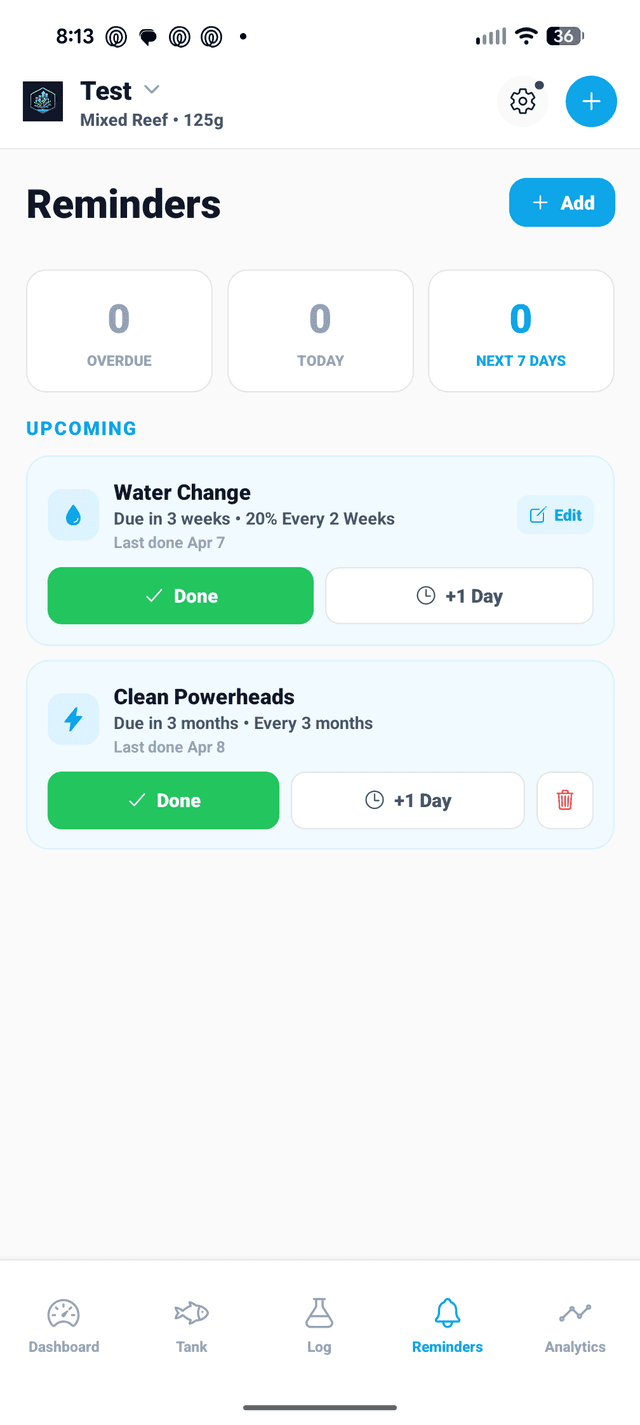
Set up a water change reminder in NextUpReef and the app will track your schedule, remind you when it's due, and log each change automatically so you never lose track of your maintenance history.
You don't need to test daily, but weekly logging tells you whether things are improving. Focus on these three:
Nitrate (NO3)
< 20 ppm
Tracks whether nutrients are improving
Should be trending down
Phosphate (PO4)
< 0.10 ppm
Main fuel for algae growth
Should be trending down
Salinity (SG)
1.024–1.026
Evaporation raises salinity weekly
Should stay consistent
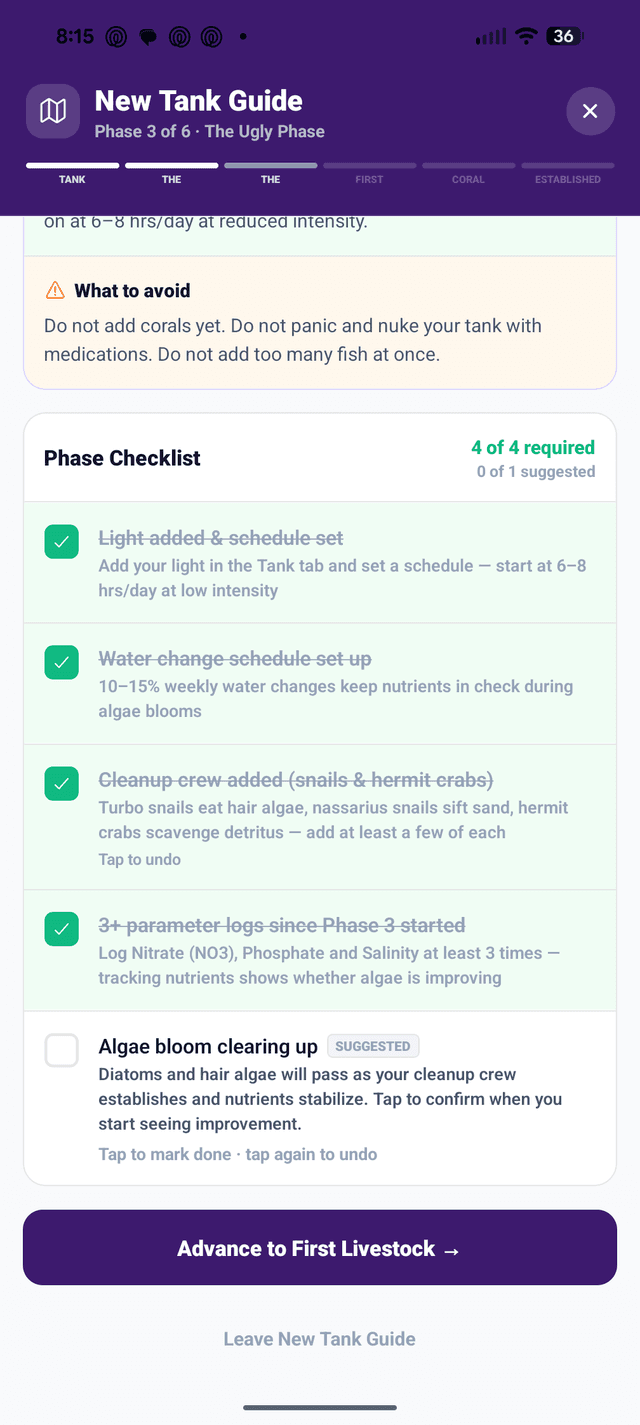
The New Tank Guide keeps you on track through the ugly phase
NextUpReef's Phase 3 checklist tells you exactly what to do during the ugly phase — lights schedule, cleanup crew, water changes, and parameter logging — all tracked automatically.
Download NextUpReef Free →There's no single moment — it's a gradual improvement. Signs your tank is turning the corner:
Algae growth slows noticeably — cleanup crew is keeping up with new growth
Rock starts showing pink or purple coralline algae spots — this is a great sign
Nitrate and phosphate readings trending down toward target range
Water is clearer and glass stays clean longer between wipes
You're not dreading looking at your tank anymore
When algae is clearing and parameters are stabilizing, you're ready to think about your first fish. That's Phase 4 — and it's when reef keeping starts to get genuinely exciting.
NEXT IN THE SERIES
Adding Your First Fish to a Reef Tank →
Your tank survived the ugly phase — now it's time for its first residents. How to choose hardy beginner fish, the one-fish-at-a-time rule, and why patience still matters even here.
