
Home › Blog › Cyano, Dinos & Hair Algae
Cyanobacteria, Dinoflagellates & Green Hair Algae: How to Beat the Three Reef Tank Pests
May 9, 2026 · 10 min read · By NextUpReef
Every reef tank will fight one of these three at some point. Cyanobacteria (cyano), dinoflagellates (dinos), and green hair algae (GHA) are the most common nuisance organisms in saltwater tanks. They look similar to a beginner — but they behave very differently, are caused by very different things, and require very different treatment approaches.
Misidentifying which one you have is the #1 reason reefers fail to treat them. The cyano treatment for cyano works. The cyano treatment for dinos makes dinos worse. This guide walks through how to identify each one, what causes it, and what actually clears it up.
Quick Identification Guide
- Cyanobacteria: Smooth slime sheet. Red, purple, dark green, or black. Peels off as a single film. Smells earthy or musty. Usually on sand and low-flow rock.
- Dinoflagellates: Brown stringy snot with air bubbles trapped inside. Disappears at night, returns by mid-morning. Often coats corals and chokes them.
- Green hair algae: Bright green, hair-like or grass-like strands attached firmly to rock. Doesn't peel off — has to be pulled or scrubbed.
- Diatoms (for context): Light brown dust coating everything. Common in new tanks. Harmless, clears up in weeks. Not in this guide.
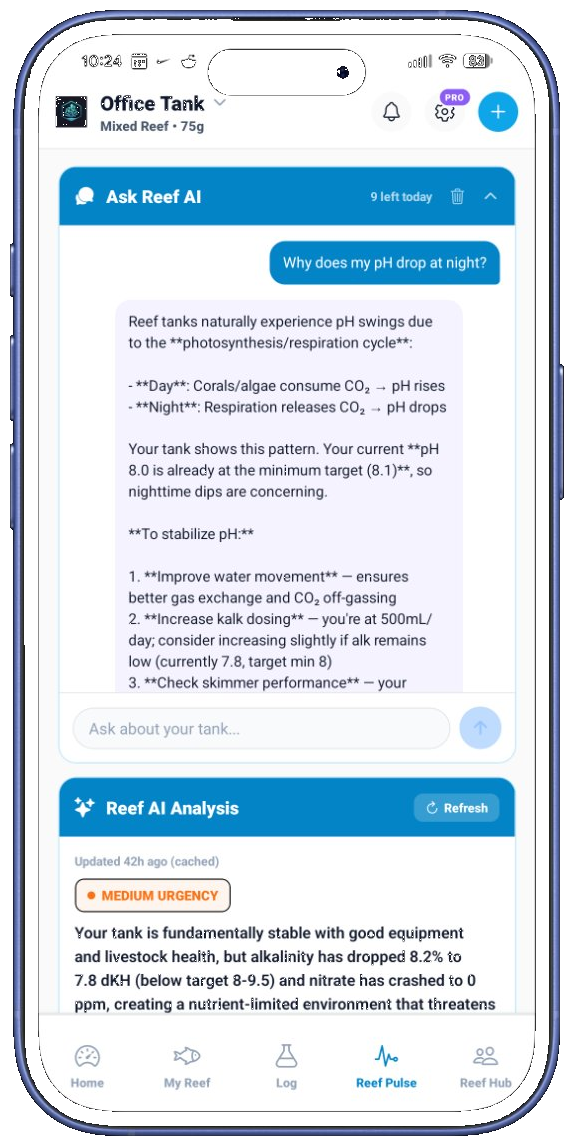
Cyanobacteria: The Easiest to Treat
Cyano is actually a bacteria, not algae. It forms a smooth, sticky sheet that looks painted on. It comes in red (the most common), purple, dark green, and black. You can usually peel it off in a single piece with a turkey baster blast or tweezers.
What feeds it:
- Excess nutrients (especially nitrate and phosphate)
- Overfeeding
- Detritus buildup in low-flow areas and dirty filter socks
- Old light bulbs (T5 or metal halide over 12 months old)
- Long photoperiod (more than 9 to 10 hours peak)
- Dead spots in the tank with no flow
How to treat cyano:
- Siphon it out during a water change. Don't just blast it — that scatters spores. Suck it directly into the change water.
- Increase flow to the affected area. Add a small wavemaker or reposition existing ones. Cyano needs still water to colonize.
- Cut your photoperiod by 1 to 2 hours per day for 2 weeks.
- Replace any T5 bulbs over 12 months old. Old bulbs shift toward yellow/red wavelengths that cyano loves.
- Reduce feeding by 30 percent for 2 to 3 weeks.
- Improve filter sock and skimmer cleaning routine. Sock changes every 2 to 3 days during treatment.
- If it persists, dose ChemiClean or Red Slime Remover as a last resort. Both kill cyano but cause oxygen crashes — run airstones overnight after dosing.
Cyano usually clears within 2 to 3 weeks of fixing the root cause. If it keeps coming back, you haven't fixed the cause — keep looking.
Dinoflagellates: The Hardest to Beat
Dinos are the nightmare pest. They look like brown snot or stringy mucus with tiny air bubbles trapped in them. They're actually microscopic toxic plankton — they release toxins that kill corals and fish over time.
What makes dinos so brutal: they grow in CLEAN tanks. Most reef pests are fueled by excess nutrients. Dinos thrive when nutrients are stripped to near zero. So well-maintained reefs running aggressive nutrient export are paradoxically the most vulnerable.
Telltale signs of dinos:
- Brown stringy growth that's always full of air bubbles (oxygen byproduct)
- Disappears overnight, comes back by mid-morning
- Nitrate reads near zero and phosphate reads near zero
- Coral polyps don't extend, even at night
- Snails are dying or staying buried in the sand
- Fish are flashing or scratching against rocks
How to treat dinos:
- RAISE your nutrients. Counterintuitive but essential. Dose nitrate (NeoNitro) to get nitrate to 5 to 10 ppm and phosphate to 0.05 to 0.1 ppm. Feed more. This is the single most important step.
- Run a UV sterilizer. 15 to 25 watts plumbed in line with water moving through it slowly. UV nukes free-floating dinos that drift through it.
- Dose live bacteria — Microbacter 7, MB7, or DR Tim's Eco-Balance — to outcompete dinos for whatever scraps remain.
- Lights off for 3 days (blackout). Cover the tank with a sheet. Many dino strains die without light. Skim heavily during the blackout to remove dead toxins.
- Stop chasing zero nutrients. Aggressive GFO, biopellets, and large skimmers create the conditions dinos love. Back off for 2 to 3 months.
- In severe cases: dose hydrogen peroxide (1 ml per 10 gallons daily for a week). Risky — research thoroughly before trying.
Dinos can take 3 to 6 months to fully resolve. They're the worst-case scenario. Identifying them correctly is half the battle — treating dinos like cyano (cutting nutrients further) accelerates the problem.
Green Hair Algae: The Most Common
GHA is the algae most new reefers fight. It looks like bright green grass or hair attached firmly to rock surfaces. You can't blow it off — you have to pull or scrub. It's actually a sign of an immature tank — almost every reef goes through a GHA phase between 4 and 12 months old.
What feeds GHA:
- High phosphate (above 0.1 ppm)
- High nitrate (above 10 ppm)
- Overfeeding
- Old, leached dry rock (still releasing bound phosphate)
- Insufficient cleanup crew
- New tanks (4 to 12 months) going through their nutrient cycle
How to treat GHA:
- Manually remove what's growing. Pull strands by hand, scrub rocks, vacuum during water changes.
- Test nitrate and phosphate. Bring nitrate under 10 ppm and phosphate under 0.07 ppm.
- Add cleanup crew — turbo snails, urchins, emerald crabs, sea hares (for major outbreaks). A foxface or rabbitfish will eat hair algae on bigger tanks.
- Run GFO (granular ferric oxide) in a reactor to bind phosphate. Replace media every 4 to 6 weeks.
- Increase water change frequency to 20 percent weekly for a month.
- Reduce feeding by 20 to 30 percent.
- Set up a refugium with chaeto — chaeto outcompetes nuisance algae for nutrients.
- Be patient. GHA takes 4 to 8 weeks to clear after nutrients are under control.
GHA usually means your nutrients are too high — but don't crash them to zero. The goal is balanced (1 to 10 ppm nitrate, 0.02 to 0.08 ppm phosphate), not absent.
The Common Thread: Track Your Nutrients
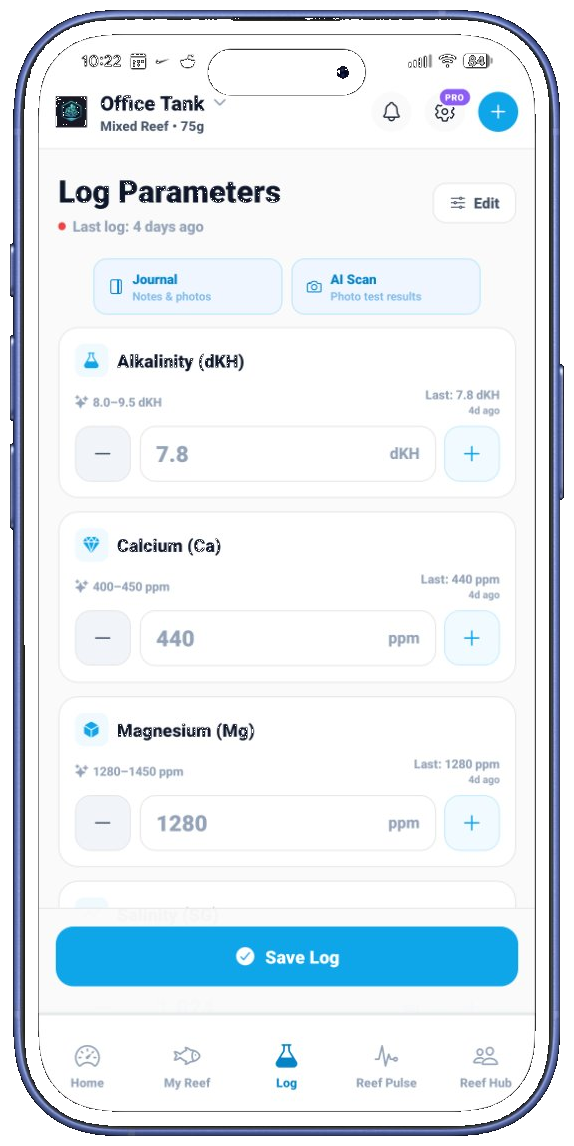
Every one of these pests is a nutrient problem in disguise — too much, too little, or imbalanced. You can't solve a nutrient problem you aren't measuring. Nitrate and phosphate should be tested weekly in any reef tank, and the readings logged so you can see trends.
A tank with stable nitrate at 5 ppm and stable phosphate at 0.05 ppm rarely has a pest problem. Tanks with swinging nutrients — feeding heavy one week, starving them the next — feed every type of nuisance organism in turn. Stability is everything.
NextUpReef logs nitrate, phosphate, and every other parameter on trend charts that show you exactly when nutrients spiked or crashed. Spot the swing, find the cause, fix it before it triggers the next outbreak. Learn about the ugly phase every new tank goes through →
Prevention: How to Avoid These Pests Long-Term
- Don't chase zero nutrients. Aim for 1 to 10 ppm nitrate and 0.02 to 0.1 ppm phosphate. Both at zero invites dinos.
- Cleanup crew from day one. Snails, hermit crabs, and conchs work full-time. A understocked tank in livestock terms is an overstocked tank in algae terms.
- Replace bulbs every 12 months if you run T5 or metal halide. LED units are fine for 3 to 5 years.
- Filter sock changes weekly. Letting socks sit a month is a nutrient release event.
- Refugium with chaeto. A working refugium prevents most nuisance algae outbreaks from ever starting.
- Test weekly, not when you notice problems. By the time you can see GHA, your phosphate has been elevated for weeks.
Final Thought
Every reefer fights one of these eventually. Don't panic when you see it — identify it correctly first, then treat the cause. The biggest mistakes are misidentifying (treating cyano like algae, or dinos like cyano) and reacting too aggressively (a massive water change, dosing chemicals on day one). Slow, deliberate, and patient wins these battles.
Track your reef tank with NextUpReef — free.
Log every test, watch nutrient trends, and let AI flag the conditions that trigger nuisance algae. iOS and Android.