April 2026 · 9 min read
The nitrogen cycle is the single most important concept in reef keeping. It's also the most misunderstood — and skipping it, rushing it, or misreading it is responsible for more dead fish and crashed tanks than any other mistake beginners make.
The good news: you don't need to understand organic chemistry to cycle a tank successfully. You just need to know what's happening, what to test, and what the numbers mean. This guide covers all of it.
When organic matter breaks down in your tank — fish waste, uneaten food, dead organisms — it produces ammonia (NH3). Ammonia is highly toxic to fish and invertebrates at even low concentrations. A tank without an established bacterial colony will accumulate ammonia fast enough to kill fish within days.
The nitrogen cycle is the process by which two different species of beneficial bacteria colonize your rock and sand, and convert that toxic ammonia into progressively less harmful compounds:
Ammonia (NH3)
From fish waste / dosing
Extremely toxic
→ Nitrosomonas bacteria →
Nitrite (NO2)
Toxic intermediate
Very toxic
→ Nitrospira bacteria →
Nitrate (NO3)
Safe end product
Manageable with WCs
Nitrosomonas are the first bacteria to establish. They consume ammonia and produce nitrite as a byproduct. Then Nitrospira colonize and convert nitrite to nitrate. Nitrate is relatively harmless at low levels and is removed through regular water changes.
When ammonia and nitrite both drop to zero — and you can detect nitrate — your tank is cycled. That's the finish line.
Honestly? It depends. Here's a realistic breakdown:
A slow cycle is a normal cycle. If you're at week 5 and still seeing nitrite, that's not a problem — it means bacteria are still establishing. Don't do a large water change, don't add fish, don't panic. Just keep testing.
During the cycle you need to test three parameters: ammonia, nitrite, and nitrate. Test every 2–3 days. More often when you think you're approaching the finish line.
⚗️
Ammonia (NH3)
0 ppm
Should spike then drop to 0
⚠️
Nitrite (NO2)
0 ppm
Will spike after NH3 drops
✅
Nitrate (NO3)
> 0 ppm
Rising NO3 = cycle working
Don't use test strips. They're not accurate enough to track a cycle. You need a liquid test kit — API Master Saltwater is fine for beginners, Salifert kits are more accurate. The difference between 0.5 ppm and 0 ppm of ammonia matters enormously when you're deciding whether it's safe to add fish.
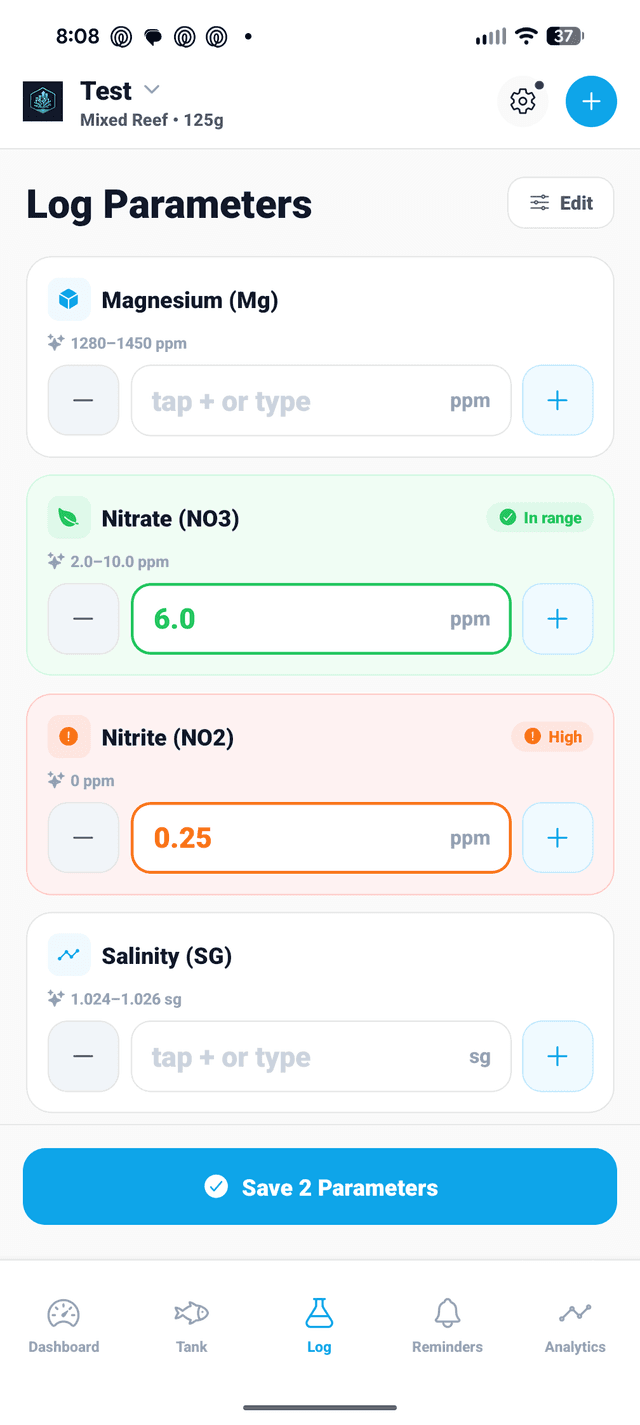
NextUpReef automatically adds ammonia, nitrite, and nitrate to your log screen during Phase 2 of the New Tank Guide — so you never forget what to test during the cycle.
Dose ammonia to 1–2 ppm
Use pure ammonium chloride solution — Dr. Tim's Ammonium Chloride is widely available. Add enough to reach 1–2 ppm, then test immediately to confirm. Don't exceed 2 ppm — high ammonia can actually slow bacterial establishment.
Add bottled bacteria
Dr. Tim's One & Only or FritzZyme 900 contain live nitrifying bacteria. Shake well and add the full bottle. This seeds your tank with the bacteria you need and can cut weeks off your cycle time.
Test every 2–3 days
Log every reading. You're watching for: ammonia to climb, then slowly drop. Nitrite to appear and climb as ammonia drops. Then nitrite to drop and nitrate to appear. The pattern tells you where you are in the cycle.
Redose if ammonia drops below 0.5 ppm before nitrite spikes
Bacteria need a food source to establish. If your ammonia is already dropping to near zero before you see any nitrite rise, redose ammonia back to 1–2 ppm. Don't let it starve the bacteria colony you're trying to grow.
Wait for both NH3 and NO2 to hit zero
This is the moment. Log a reading of 0 ammonia and 0 nitrite on the same day, with some nitrate present. Your tank is cycled. Wait 24–48 hours and test again to confirm it holds before adding any livestock.
Don't do large water changes
This washes out the bacteria you're trying to grow. Small top-offs for evaporation are fine, but avoid any significant water changes until the cycle is complete.
Don't add fish or corals
Ammonia and nitrite will kill fish at any detectable level. Corals will be severely stressed. Nothing alive goes in until both read 0.
Don't turn the lights on
No cleanup crew, no algae grazers — lights will trigger a diatom and green hair algae bloom that's harder to deal with when you do eventually add livestock.
Don't add a cleanup crew
Snails and hermit crabs need stable, cycled water. Ammonia kills them just as effectively as it kills fish.
Don't give up if it's slow
Some tanks take 8 weeks. Temperature, ammonia source, water flow, and rock surface area all affect cycle time. A slow cycle just means bacteria are still establishing — they will get there.
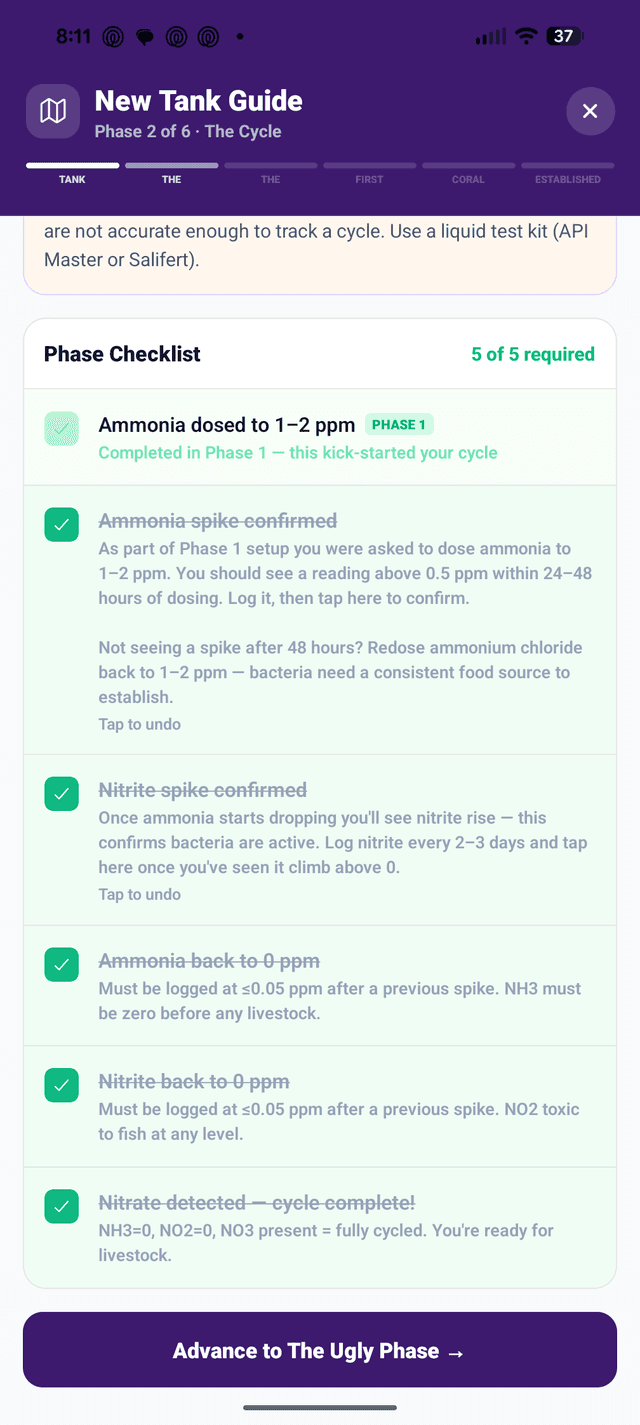
Track your cycle progress automatically
NextUpReef's New Tank Guide tracks your cycle step by step. Log your ammonia, nitrite, and nitrate readings and the app automatically detects when each milestone is reached — no guesswork.
Download NextUpReef Free →You're cycled when all three of these are true at the same time:
Ammonia (NH3) = 0 ppm
Nitrite (NO2) = 0 ppm
Nitrate (NO3) > 0 ppm (some is present)
Test again 24–48 hours later to confirm the readings hold. If they do — congratulations. Your tank is ready for its first residents. Head to Phase 3: The Ugly Phase.
NEXT IN THE SERIES
The Ugly Phase: Why Your Tank Looks Terrible (And Why That's Normal) →
Diatoms, green hair algae, cyano — your tank is about to get ugly. Here's why it happens, how long it lasts, and what to do about it.
